

How Self-Dumping Hoppers Speed Up Waste Removal
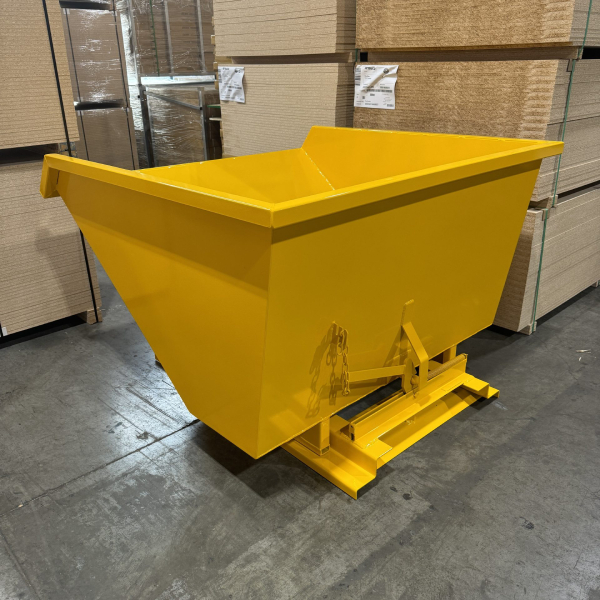
At Unitran Manufacturers, we build equipment for facilities where waste removal happens every shift, not once a week. When scrap, packaging material, and production offcuts pile up continuously, the method used to clear them has a direct effect on how efficiently everything else runs. Self-dumping hoppers speed up waste removal by replacing slow, labour-intensive handling with a single, forklift-driven process, and the operational difference is significant enough to change how a facility runs day to day.
The Problem With Manual Waste Handling
Most facilities manage waste with a combination of smaller bins, manual tipping, and multiple trips to the dumpster. That works until the volume of waste outpaces the method. The typical failure points are straightforward:
- Workers make repeated trips hauling smaller containers across the floor
- Emptying requires manual tipping, which means climbing, lifting, or reaching into containers
- Bins fill faster than they’re cleared, creating staging bottlenecks near workstations
- Standard bins crack or deform under repeated rough handling, shortening their service life
Each of these problems burns time and pulls workers away from productive tasks. The solution isn’t better scheduling; it’s better equipment.
How Self-Dumping Hoppers Work in Practice
A self-dumping hopper is a steel container with forklift pockets built into the base and a gravity-operated release mechanism on the front. The forklift lifts the hopper, moves it to the disposal point, and when the unit reaches dump height, the front gate releases and the container tilts forward automatically. Once emptied, it resets and is ready for the next load.
This process eliminates the manual steps that slow conventional waste removal down:
- No worker needed to tip or empty the container
- No climbing on or into the bin
- Collection and disposal handled in a single pass by one operator
- The hopper returns to position ready for continued use
For facilities handling scrap metal, packaging waste, or wood offcuts throughout the day, this approach consolidates what used to be multiple small trips into one efficient cycle per load.
Find out if a self-dumping hopper is the right choice for your operation.
Where the Time Savings Actually Come From
The efficiency gain from self-dumping hoppers isn’t a single dramatic improvement; it’s the accumulation of smaller time savings across every shift. Understanding where those savings come from helps make the case for the switch.
Fewer Trips per Shift
Hoppers hold significantly more volume than the smaller bins most facilities use for spot collection. Centralizing waste into one large container means fewer trips to the disposal area and longer intervals between dump cycles. Workers stay focused on their tasks instead of breaking off to manage waste.
One Operator, One Pass
With manual bins, emptying often requires two people or a worker with enough time to manage the full tipping and repositioning process. A self-dumping hopper handled by a forklift operator takes one person, one lift, and one pass. The operator doesn’t leave the seat.
Less Equipment Failure
Standard bins take punishment on a warehouse floor. Forks puncture the sides, bases warp from repeated loading, and hinges fail from stress they weren’t designed to handle. Purpose-built self-dumping hoppers are constructed with the expectation that a forklift will engage them multiple times a day. Reinforced steel frames, integrated forklift pockets, and durable welds are standard, not upgrades. Equipment that holds up under daily use doesn’t create the reorder cycles and workflow disruptions that failed bins do.
Learn more benefits of using self-dumping hoppers.
The Safety Component
Faster waste removal is a clear operational benefit, but the safety improvement deserves equal attention. Manual waste handling involves repetitive lifting of heavy or awkward loads, workers reaching into or climbing on containers to tip them, and people on foot managing bins in areas where forklifts are moving. Self-dumping hoppers remove the worker from most of those situations. The forklift handles the lift, the mechanical release handles the dump, and the operator stays on the equipment. In facilities where WorkSafeBC compliance is an ongoing focus, reducing manual material handling contact points is a practical and documentable improvement.
Durability as a Running Cost Factor
Waste equipment that fails under daily use doesn’t just create a one-time replacement cost. It creates a recurring cost pattern that compounds over time. The real question isn’t what a hopper costs upfront; it’s how often it needs to be replaced and what downtime it creates when it fails mid-shift.
Hoppers built from heavy-gauge welded steel, finished with corrosion-resistant coatings, and designed specifically for repeated forklift engagement hold up in conditions that destroy standard bins quickly. That durability makes the equipment a long-term operational decision rather than a short-term fix.
Getting the Right Equipment in Place
The shift from manual bins to self-dumping hoppers isn’t a major operational overhaul. Most facilities already have the forklift capacity to run them. What changes is the efficiency of every waste removal cycle from the first day they’re in use.
If your current waste removal process is creating repeated trips, safety exposure, or equipment that doesn’t last, we’d be glad to walk through what self-dumping hoppers can do for your operation. Reach out to us at 604-574-3465 to talk through what fits your facility’s volume and workflow.


