

Storage Solutions for Small Warehouse Spaces
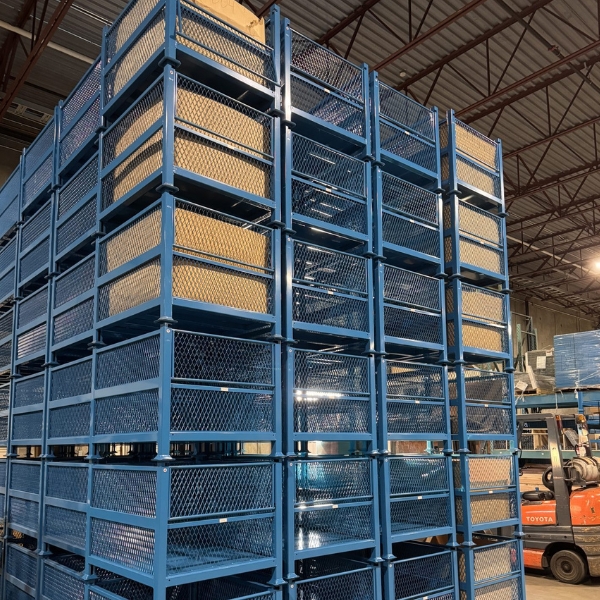
Running out of room doesn’t always mean running out of options. For warehouse operators working within tight footprints, the right approach to storage for small warehouse spaces is less about finding more square footage and more about using what’s already there more precisely. At Unitran, we work with operators who need equipment built to last and configured to work, not systems that look good on paper but fail under daily operational loads.
Learn some best practices for storing bulk materials.
Measure Before You Spend
Before purchasing new equipment, establish a baseline. Cube utilization (the ratio of stored goods volume to total available storage volume) tells you where your space is actually going. Most facilities underperform here, leaving usable vertical space untouched while floor congestion drives up pick times and error rates.
Walk your racking rows and ask:
- Are beam heights adjusted to actual load dimensions, or set to a default?
- Are pallet rack bays being used for small parts that belong in bin shelving?
- How much floor space is consumed by staging that has no defined location?
Answering these questions costs nothing. The answers often recover usable capacity before any new equipment is ordered.
Go Vertical First
Ceiling height is the most underused asset in small warehouse operations. Most facilities dedicate equipment and attention to the floor plan while the upper cube sits empty.
Learn how to maximize your warehouse’s storage space.
Racking Height and Forklift Reach
Increasing storage height requires matching your racking specification to your lift equipment’s reach capability and your floor’s load rating. These determine whether a taller system is actually usable or just occupies your footprint without adding accessible capacity.
Narrow Aisle Configurations
Reducing aisle width from standard to narrow-aisle or very narrow-aisle configurations can reclaim significant floor space. The trade-off is equipment: narrow aisles require hand trucks or order pickers rather than counterbalance forklifts. For operations with moderate pick volumes, the storage density gain justifies the equipment investment.
Build for Reconfiguration, Not Just Right Now
Small warehouse inventories change. SKUs get added, product dimensions shift, and seasonal peaks require different slotting. A storage system that can’t adapt becomes a fixed liability.
Adjustable beam heights, compatible upright systems, and modular bay configurations let you respond to those changes without replacing infrastructure. This is where durability compounds over time: a well-built, reconfigurable system in service for fifteen years outperforms a cheaper fixed system replaced twice over the same period.
Right-Size Your Equipment to Your Inventory
Mismatched storage is one of the most common sources of wasted space. Pallet racks used for small, loose parts waste vertical capacity. Bin shelving used for heavy or oversized product wears out quickly and creates access problems.
The fix is straightforward. Slot pallet racking for full or half pallets, use bin shelving, drawer cabinets, or flow rack for small-parts storage, and designate fixed locations for each inventory category. When equipment is matched to the actual load, density improves and wear is distributed correctly.
Put the Space You Have to Work
Small warehouse constraints are real, but they’re usually solvable without expanding your lease. If you’re reassessing your layout and want to talk through storage equipment built for long-term service, reach out to us through our website contact form and we’ll work from what your operation actually needs.


