

How Warehouse Layout Affects Equipment Needs
At Unitran Manufacturers, we work with operations buyers and warehouse managers who are solving real problems: bottlenecks at receiving, workers avoiding certain equipment, hand trucks that keep failing ahead of schedule. In many cases, the root cause isn’t the equipment itself. It’s a mismatch between what the layout actually demands and what was purchased to meet those demands. Getting this alignment right reduces downtime, cuts replacement costs, and keeps your crew working instead of working around problems.
Aisle Width Sets the Boundaries on Everything Else
Aisle configuration is the first constraint your equipment has to work within, and it’s one of the most commonly overlooked.
Narrow aisles, particularly those under eight feet, limit what equipment can physically move through them. Carts that work fine on an open floor become obstacles in tight picking zones. Rolling ladders need both horizontal clearance and adequate overhead clearance to position safely.
When equipment size doesn’t match aisle dimensions, the results are predictable. Workers skip using equipment and carry loads manually, increasing injury risk. Carts and hand trucks take repeated impacts navigating tight turns, shortening their service life. Congestion at choke points slows throughput and creates frustration on the floor.
Find out when you should replace your material handling equipment.
Flow Pattern Determines How Hard Equipment Works
How product moves through your facility directly affects the wear and frequency demands placed on manual handling equipment. The three most common flow patterns each create different requirements.
U-Shaped Layouts
Receiving and shipping share the same side of the facility. Travel distances are shorter, but equipment cycles more frequently. The priority is quick-turn durability: hand trucks and carts that hold up under high repetition, not just high loads.
I-Shaped (Through-Flow) Layouts
Product enters one end and exits the other. Longer travel distances put more cumulative stress on equipment and on workers. Ergonomic handle design and larger wheel diameter matter here because they reduce fatigue and rolling resistance over distance, extending both equipment life and worker productivity.
L-Shaped Layouts
These facilities require versatility. Equipment often handles short positioning moves in one zone and longer transfers in another. A cart or hand truck that performs well in one context but fails in the other creates gaps in your operation.
The wrong equipment for your flow pattern doesn’t fail immediately. It degrades. You see it in more frequent maintenance, more equipment pulled from service, and workers developing workarounds that reduce efficiency.
What storage solutions should you use for a small warehouse space?
Vertical Storage Creates Specific Access Requirements
Maximizing vertical space is a practical response to the cost of square footage. But high shelving and mezzanine storage create access demands that require the right equipment to manage safely and efficiently.
Height rating matters first: rolling ladders need to match actual working heights, not approximate them. An undersized ladder creates safety risk; an oversized one wastes space and maneuverability. Access frequency is the next factor. High-reach locations accessed multiple times per shift need mobile ladder solutions that reposition quickly and lock securely. Step and railing standards round out the picture. Non-slip steps and proper railings keep access equipment functional under daily use without incident.
Vertical storage saves real estate cost. The equipment you use to access it determines whether those savings translate to productivity or get absorbed in slow access times and safety issues.
Storage Method Creates Hidden Equipment Demands
The way product is stored defines what you’re actually moving and how, and that drives specific equipment requirements that aren’t always obvious at the purchasing stage.
- Bin and small-parts operations benefit from multi-shelf carts that support batch picking efficiently.
- Single-deck equipment creates extra trips and slows pick rates.
- Bulk and loose material handling calls for self-dumping hoppers, which eliminate repetitive manual lifting. Operations that skip this see more strain injuries and slower material transfer.
- Cylinder and drum storage presents awkward load geometry that requires hand trucks rated for off-centre weight distribution.
- Standard hand trucks used on cylinders wear out faster and create handling risks.
- Stacking systems need compatible handling equipment. Mismatched combinations create instability and damage product.
When equipment doesn’t match the storage method, operations compensate with workarounds. Those workarounds increase handling time, raise injury risk, and accelerate equipment wear.
The Practical Takeaway
Layout isn’t just a space planning decision; it sets the actual performance requirements for every piece of manual handling equipment in your facility. Aisle dimensions, flow pattern, vertical storage strategy, and storage method each create specific demands, and equipment that doesn’t meet those demands costs more over time through replacement cycles, downtime, and reduced productivity.
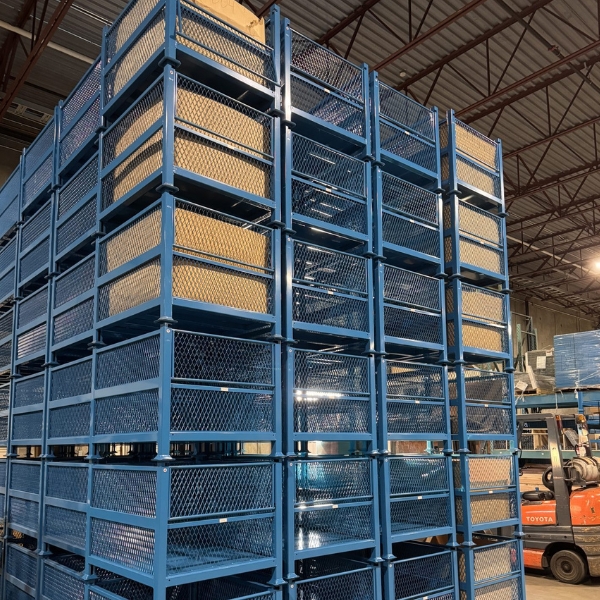
Our team manufactures hand trucks, carts, rolling ladders, self-dumping hoppers, stacking baskets, and related equipment built for the kind of daily use that exposes mismatches fast. If you’re evaluating your current equipment against your layout requirements, call us at 604-574-3465. We can help you identify where the gaps are and what’s built to fill them.


