

Choosing Between a Platform Truck and a Hand Truck
At Unitran Manufacturers, we work with warehouse managers and operations buyers who need material handling equipment that holds up under daily use. One of the most practical decisions in that category is also one of the most commonly misjudged: choosing between a platform truck and a hand truck. Getting this wrong costs you in damaged product, worker strain, and equipment that wears out faster than it should. Getting it right means fewer interruptions and fewer repeat orders.
How Each Truck Handles a Load
The difference between these two tools comes down to load orientation and who’s responsible for stability.
Hand trucks use a two-wheeled, vertical frame. The operator tilts the load back onto the frame and balances it during transport. That works well for stacked boxes or cartons with a stable centre of gravity, tall loads that can lean against the frame without shifting, and repetitive short-distance moves where speed matters.
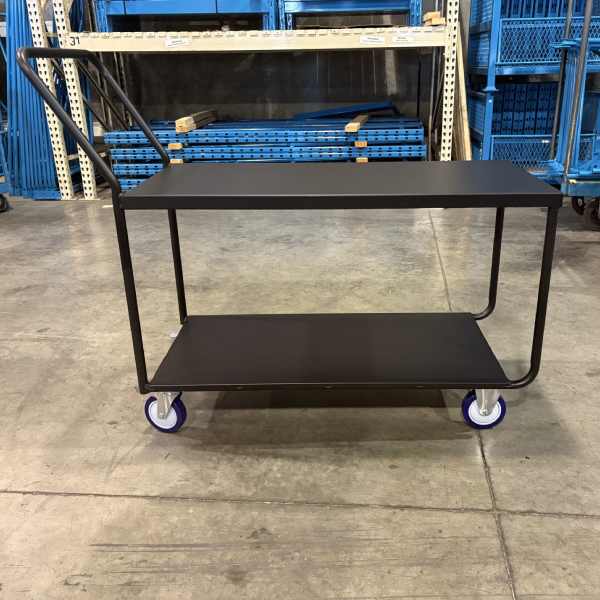
Platform trucks use a four-wheeled flat deck. The load sits level and stays level without operator input. That’s the right choice for items that can’t be tilted without damage or spillage, awkward or uneven shapes that won’t stack cleanly on a hand truck frame, and heavier loads distributed across a wide footprint.
If your team is regularly improvising to get a load onto a hand truck that wasn’t designed for one, that’s a signal you need a platform truck for that application.
Find out when you should replace your material handling equipment.
Workspace and Maneuverability
Neither truck is universally superior here. The real question is what your floor plan demands.
Hand trucks have a narrow footprint. They move efficiently through tight aisles, standard doorways, and congested staging areas. The two-wheel design lets experienced operators work quickly in confined spaces.
Platform trucks require more turning radius. Four wheels give you stability on open warehouse floors, but they slow you down in tight quarters. On smooth concrete, they move with minimal effort. On uneven or rough surfaces, load stability and operator control both become harder to maintain.
Floor surface also affects long-term equipment wear. Weight concentrated on two wheels under a heavy load creates more point stress on both the frame and the wheels. Four-wheel platform distribution reduces that stress, which matters when equipment runs multiple shifts.
Operator Efficiency and Physical Demand
Both tools reduce manual carrying, but they create different physical demands across a shift.
Hand trucks require the operator to tilt and balance the load for the full duration of transport. On short, frequent runs, that’s manageable. Over a full day of varied loads, it adds up. The tilting motion also requires correct technique to avoid strain on the lower back.
Platform trucks eliminate the tilt. Loading requires a lift at deck height, but once the load is on, the operator pushes rather than balances. For all-day use with varied load types, that’s a meaningful difference in cumulative physical demand.
Matching the right tool to the task reduces worker fatigue and the kind of incremental injuries that don’t show up in a single incident report but do show up in productivity and absenteeism over time.
Learn all about the load capacity ratings on steel carts.
Durability and the Cost of the Wrong Choice
This is where equipment selection has a direct line to your operating budget.
Hand trucks have fewer components: two wheels, a frame, a toe plate. Fewer parts means fewer failure points, but those parts absorb significant impact. Repeated heavy loading, improper tilting, and use on rough surfaces accelerate wear on the frame and wheels.
Platform trucks carry more components and have more points to maintain, but they distribute load stress across the entire frame and four wheels. That balance means individual components don’t absorb the same concentrated stress.
What both have in common is that durability depends on the quality of construction. Welded steel frames outlast bolted or crimped alternatives under daily warehouse use. Powder coating protects against the moisture, cleaning chemicals, and UV exposure that warehouse equipment routinely faces. Equipment built with those details handles frequency of use that cheaper alternatives won’t.
The other cost to account for is using the wrong tool for the job. A hand truck forced into a platform-truck application puts stress on the frame it wasn’t designed to handle. The outcomes are product damage, slower movement, and premature equipment failure. None of that shows up in the purchase price, but all of it shows up in operating costs.
Making the Right Call
Use a hand truck when loads are stackable, stable, and can be safely tilted, when your routes are tight or involve multiple quick moves, or when speed and agility through confined spaces are priorities.
Use a platform truck when loads need to stay level or can’t be safely tilted, when you’re moving across open floor space with larger or heavier loads, or when operator fatigue over a full shift is a factor.
Most operations need both. The mistake is treating one as a substitute for the other.
Talk to Us Before You Order
If you’re evaluating material handling equipment for your facility, we’re glad to help you work through the specifics: load types, floor conditions, frequency of use, and workspace constraints. At Unitran Manufacturers, we’ve been building commercial-grade material handling equipment since 1965, and we know what holds up and what doesn’t. Reach our team at 604-574-3465 to get straightforward guidance before you commit to a purchase.


