

Understanding Load Capacity Ratings on Steel Carts
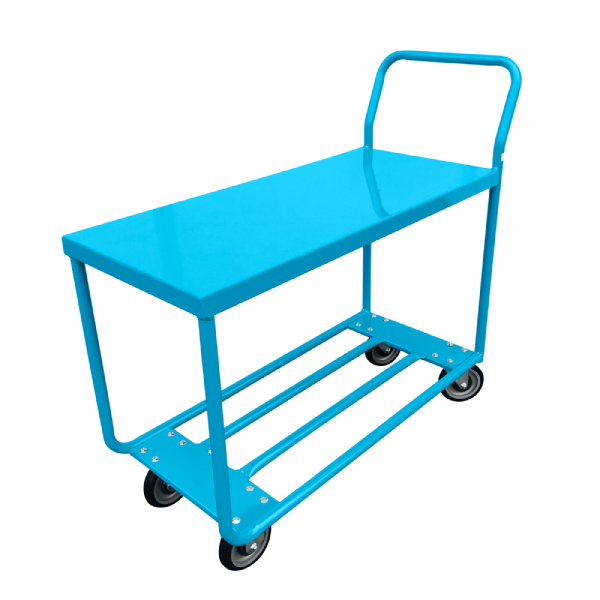
At Unitran Manufacturers, we work with warehouse managers and operations buyers making real purchasing decisions with real consequences. One of the most common points of confusion we see is around load capacity ratings on steel carts: what those numbers actually mean, how they’re determined, and how to use them to spec equipment that holds up under daily use without creating downtime or driving repeat orders.
What a Load Capacity Rating Actually Tells You
A load capacity rating is not the point at which a cart breaks. It is the maximum weight the cart can safely carry under normal operating conditions, accounting for repeated use over time. That distinction matters in a high-cycle warehouse environment.
Ratings are calculated with a safety factor built in, which is the difference between the cart’s ultimate structural strength and its rated capacity. A higher safety factor means more margin between everyday use and the failure point. It also means the equipment handles unexpected peaks without compromising the frame or casters.
At Unitran Manufacturers, conservative safety factors are a design priority, not a marketing term. That margin is what separates equipment that lasts from equipment that degrades quietly until it fails at the wrong moment.
Find out when you should replace your material handling equipment.
Factors That Affect Real-World Capacity
The number on the spec sheet assumes ideal conditions. Real warehouse environments rarely match that. Several factors reduce effective safe capacity in practice:
- Load distribution: Ratings assume weight is spread evenly across the cart’s surface. Concentrated point loads, such as a single heavy component sitting on one corner, create stress that exceeds what the number alone suggests.
- Floor surface: Rough, uneven, or inclined surfaces transfer additional stress through the casters and into the frame. A cart rated for a specific load on a smooth floor is working harder on a cracked concrete surface.
- Caster quality: Casters are a load path, not just a convenience feature. Poor casters create stress concentrations that compromise the frame even when the cart is technically within its rated capacity.
- Frequency of use: Equipment used constantly accumulates fatigue faster than equipment used occasionally. High-cycle operations need to weight this factor accordingly when selecting equipment.
- Overhang and imbalance: Loads that extend past the cart’s footprint or sit unevenly create leverage that amplifies stress on the frame, independent of total weight.
These aren’t edge cases. They’re the actual conditions your equipment runs in every day. Ignoring them when selecting a cart is how operations end up replacing equipment sooner than the spec sheet implied they would.
Learn how to choose the right two-shelf cart.
How to Select the Right Capacity for Your Operation
Matching cart capacity to your actual operation comes down to a few straightforward principles.
Base Your Selection on Your Heaviest Realistic Load
Use the upper end of your normal weight range, not your average load. Your cart needs to handle the heavy days, not just the typical ones. If your loads occasionally spike above the average, that’s the number driving your selection.
Build in Headroom
Running equipment at its maximum rated capacity consistently accelerates wear and reduces effective service life. Selecting a cart where your heaviest realistic load falls comfortably within the rating, rather than at the ceiling, gives you operational flexibility and extends the life of the equipment.
Account for How Your Operation May Change
Operations scale. Product lines shift. Loads get heavier. Slight over-capacity now is significantly cheaper than premature replacement later. If there’s a reasonable chance your throughput or load weight increases in the next few years, factor that in at the selection stage.
Match the Equipment to the Environment
A cart rated for a given load on flat, smooth surfaces needs a higher rating to perform the same function on rough floors, ramps, or uneven surfaces. The environment is part of the load equation.
What Happens When Capacity Is Exceeded
Exceeding a cart’s rated capacity doesn’t always result in immediate, visible failure. That’s part of what makes it a persistent operational problem.
The more common outcome is gradual degradation:
- Frames develop stress cracks or permanent deformation
- Welds fatigue over repeated cycles
- Casters wear unevenly or fail prematurely
- The cart continues to function, but with reduced structural integrity and unpredictable failure risk
By the time the damage is visible, the equipment is already compromised. The costs extend beyond the cart itself. Product damage, facility damage, and the downtime that comes with an unplanned equipment failure mid-operation are the real expenses.
Selecting equipment with the right rated capacity and appropriate safety factors eliminates most of this risk before it starts.
Getting Capacity Selection Right the First Time
Load capacity ratings are a starting point, not a complete picture. Understanding what they include and what they assume is how you make purchasing decisions that hold up in actual operation rather than just on paper.
If you’re evaluating steel carts for your warehouse and want to talk through the right capacity for your application, reach out to our team. We can help you match the equipment to your workload so you’re not dealing with the cost of the wrong call six months from now. Contact us at 604-574-3465.


